Cell biology: Observing the vibrations of a molecule
An optical microscope capable of resolving matter down to the atomic scale. Impossible. And yet researchers have succeeded in producing images of the vibrations of a biological molecule. An incredible first! “We have known since…

An optical microscope capable of resolving matter down to the atomic scale. Impossible. And yet researchers have succeeded in producing images of the vibrations of a biological molecule. An incredible first!
“We have long known that all the dynamic processes of life are linked to molecular vibrations,” recalls V. Ara Apkarian, a chemist at the University of California, Irvine (United States). Hence the importance of the work he carried out with his team. “The frequencies of vibration modes were already accessible to us through spectroscopy. But today, for the first time, we have been able to observe individual atoms vibrating within a molecule.”
The molecule the researchers focused on is a cobalt-containing porphyrin molecule. Porphyrins are notably part of the composition of haemoglobin and therefore play an important role in the metabolism of respiration. To study their molecule, the University of California researchers used the silver tip of a scanning tunnelling microscope. Along with a laser beam designed to focus light down to the size of a single atom.
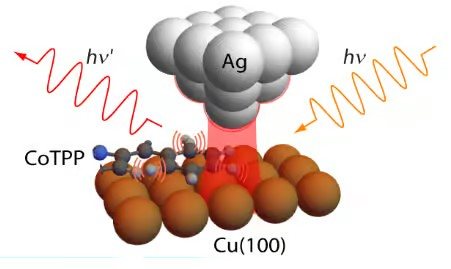
IN THE EXPERIMENT CARRIED OUT BY THE RESEARCHERS AT THE UNIVERSITY OF CALIFORNIA, LIGHT WAS FOCUSED TO THE SIZE OF AN ATOM AT THE SILVER (AG) TIP OF A SCANNING TUNNELLING MICROSCOPE AND, AIDED BY A LASER BEAM, WAS USED TO VISUALISE THE INTERNAL FUNCTIONING OF A PORPHYRIN MOLECULE (COTPP) FROZEN ON A COPPER SUBSTRATE (CU-100). © CASTL, UNIVERSITY OF CALIFORNIA
Better understanding how cells work
To avoid, in particular, the thermal agitation caused by the use of this beam, the experiment was carried out under vacuum and at the extremely low temperature of 6 kelvin, or -267.15 °C. The sample was frozen on a copper substrate. And the silver tip was able to move above the molecule at a distance of only 2 angstroms, or 2.10-10 metres, thus detecting frequency variations in different parts of the molecule.
The researchers hope to further improve the resolution of their observations, but they already believe that “this invention will revolutionise our understanding of chemical reactions and how cells function.”

