Everything vibrates, including proteins
Biologists have succeeded in observing proteins vibrating in their natural environment. Using a new imaging technique, researchers observed the vibrations of lysozyme, an antibacterial protein. LYSOZYME. Using a…

Biologists have succeeded in observing proteins vibrating in their natural environment.
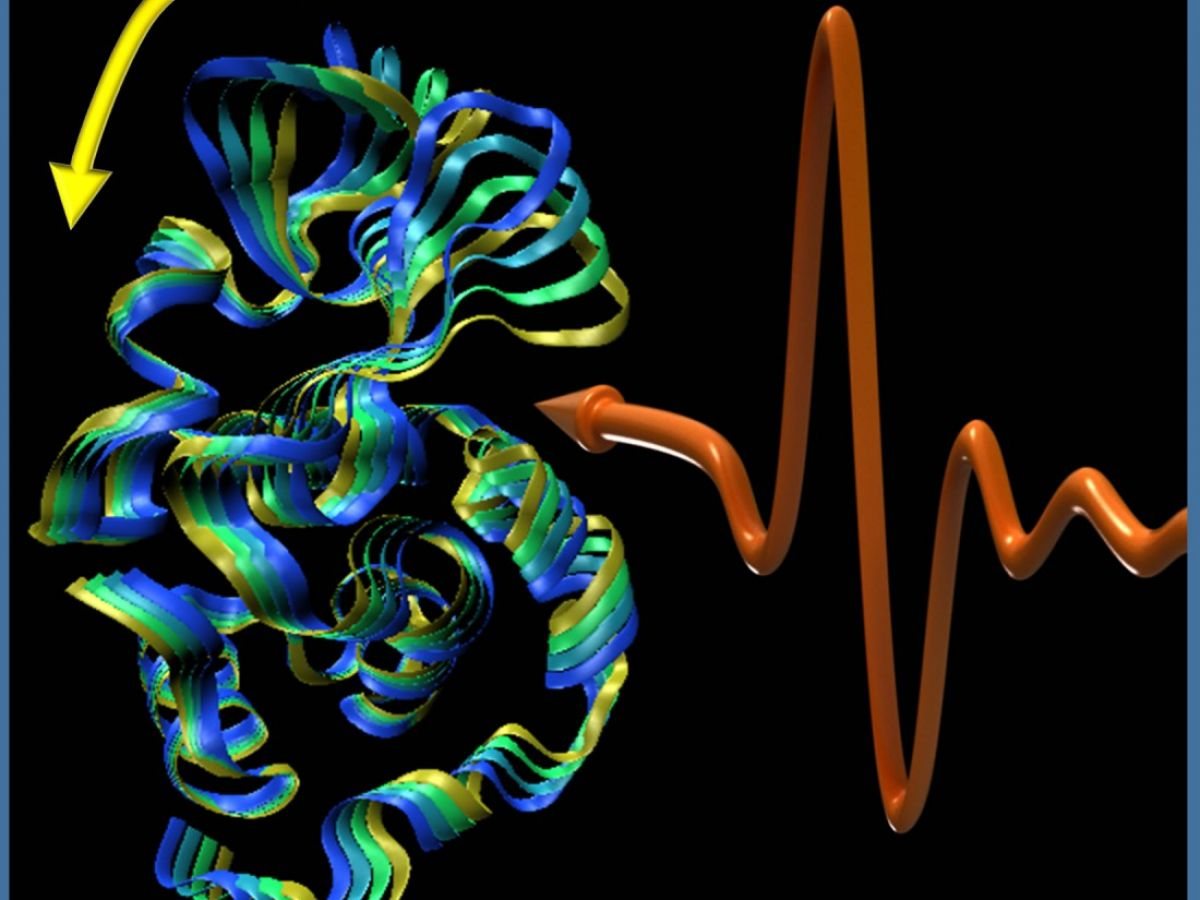
Using a new imaging technique, researchers observed the vibrations of lysozyme, an antibacterial protein.
LYSOZYME. Using a near-field microscopy technique, scientists at the University at Buffalo have observed in detail, for the first time, the vibrations of lysozyme, an antibacterial protein found in many animals.
Like the sound of a bell
To observe the vibrations of this protein, Andrea Markelz drew on an interesting characteristic: proteins vibrate at the same frequency as the light they absorb. Rather like a wine glass that resonates and shatters in response to certain sound waves. Likewise, proteins with different structures absorb and vibrate in response to light of different frequencies. The protocol for this experiment is the subject of an article in Nature Communications.
SIMPLICITY. Biologists have been trying to pin down protein vibrations since the 1960s. In the past, some have succeeded by using complex investigative methods and freezing the molecules. “Our method is much simpler. You don't need to cool the proteins or use a synchrotron light source or a nuclear reactor,” Andrea Markelz points out.
PERSISTENCE. With this stimulation method, it was possible to observe the molecules vibrating in their biological environment. The team noticed that the vibrations persisted like the sound of a bell. “If you strike a bell, it rings for a certain amount of time, and with a sound that is specific to it. That's how proteins behave,” explains Andrea Markelz.
These small vibrations allow proteins to change shape rapidly, so that they can easily bind to other proteins, a process that is necessary to carry out essential biological functions such as cell repair and DNA replication. “We can now try to understand the real structural mechanisms hidden behind these biological processes and the way they are controlled,” concludes the scientist.

